In Progress
This write-up is still being built out — more detail, photos, and files coming soon.
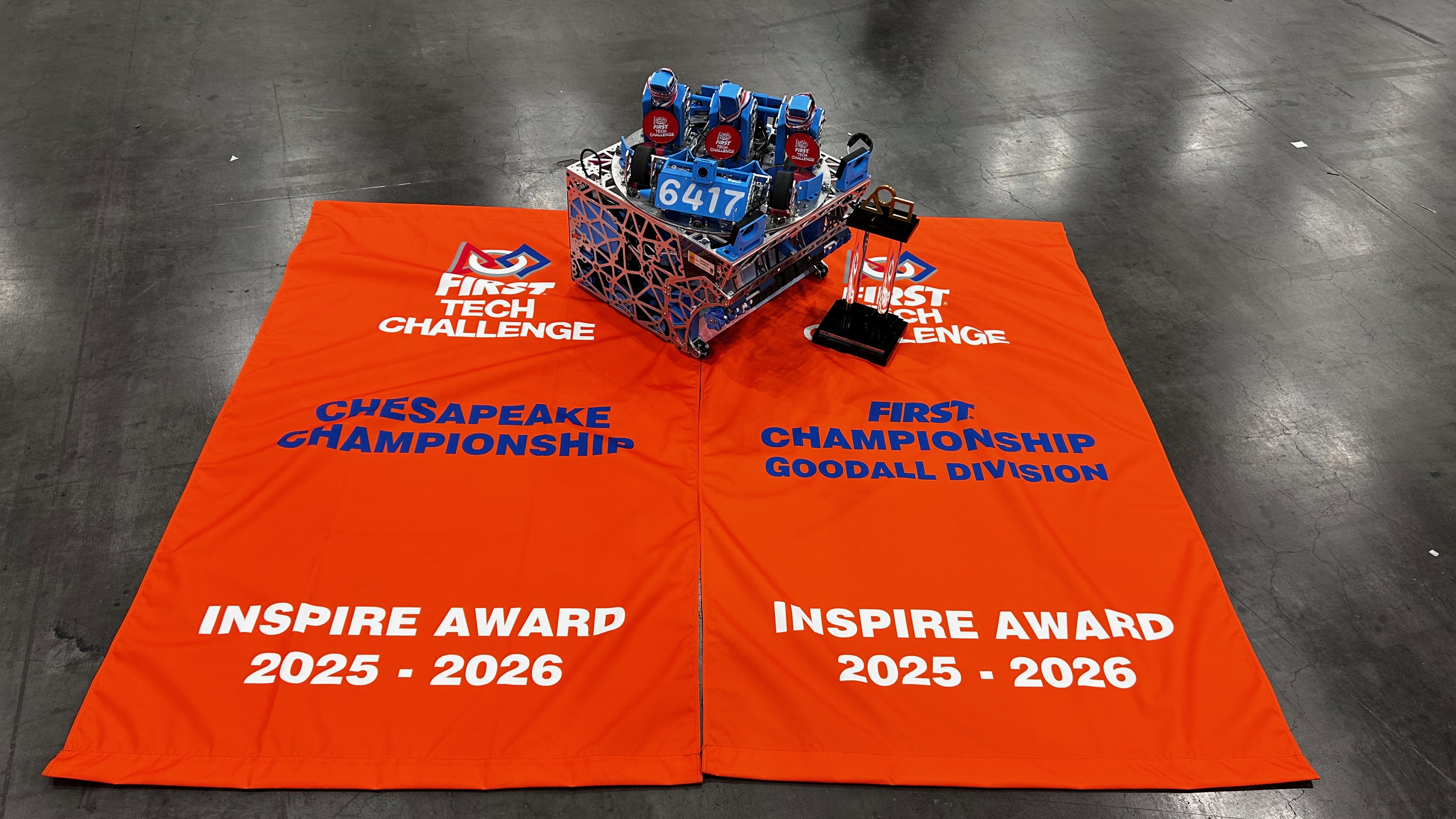
Dugtrio
The world's only robot with three shooters mounted on a turret. Where most teams shoot one ball at a time and bottleneck on sorting, Dugtrio fires three at once — or completes a motif deliberately — using three independent flywheels.
- Placed 2nd out of 8,000+ teams globally and 1st in the US
- 1st in the Chesapeake region · FTC Worlds Inspire Award
- Led mechanical design and fabrication across 150+ iterations
Triple Flywheel Shooter
- Three independent flywheels allow shooting from any distance — three shots at once, or meticulous motif completion
- Steel flywheels add rotational inertia, preserving speed and increasing shot consistency
- Independent flywheels increased accuracy by 40%
- Linked hoods freed up servos for tilt, making the turret 70% faster
- Custom "rider bearings" reduce friction; sprung wiring permits full 360° rotation
Intake & Transfer
- Full-bot-width intake with an optimized ramp profile that removes dead zones — "touch it, own it"
- Intake geometry forces artifacts to auto-align, giving the driver room for error
- V2 went channel-less with custom molded mecanum rollers and Teflon: over 70% faster pickup
- Countersprung elevator linkage balances gravity — V2 needs less than half the torque of V1
- Surgical tubing acts as a one-way door; a virtual four-bar kicker keeps the transfer short enough to turret while moving
Drivetrain & Endgame
- A 50 lb six-wheel drivetrain, chosen over mecanum through tradeoff analysis — getting pushed while shooting three artifacts was the key risk
- Central traction wheels provide pushing power; omni-wheels keep turning smooth
- Two-stage serpentine belt drive allows tighter packaging, with motors low to reduce center of mass
- Endgame tilt uses a 1:8 gearbox to tilt the 50 lb robot, doubles as a parking brake, and overcenters to stay up even without power
Software & Controls
- Auto-aim for both turret and shooter using linear interpolation
- Custom AI ball detection enables driverless intaking
- Custom Pure Pursuit pathing algorithm developed for the six-wheel drive
Design Process
- Requirements analysis drove every subsystem — each game observation mapped to a design consequence
- Brainstorming sprints and 12+ prototypes in PLA, polycarbonate, and cardboard
- Finite Element Analysis optimized pocketing to reduce deformation by 4x
- Multibody modeling and master sketches in Onshape enabled fast top-down changes
- Failure Mode and Effects Analysis after each competition; version control enabled experimentation