In Progress
This write-up is still being built out — more detail, photos, and files coming soon.
Blastoise
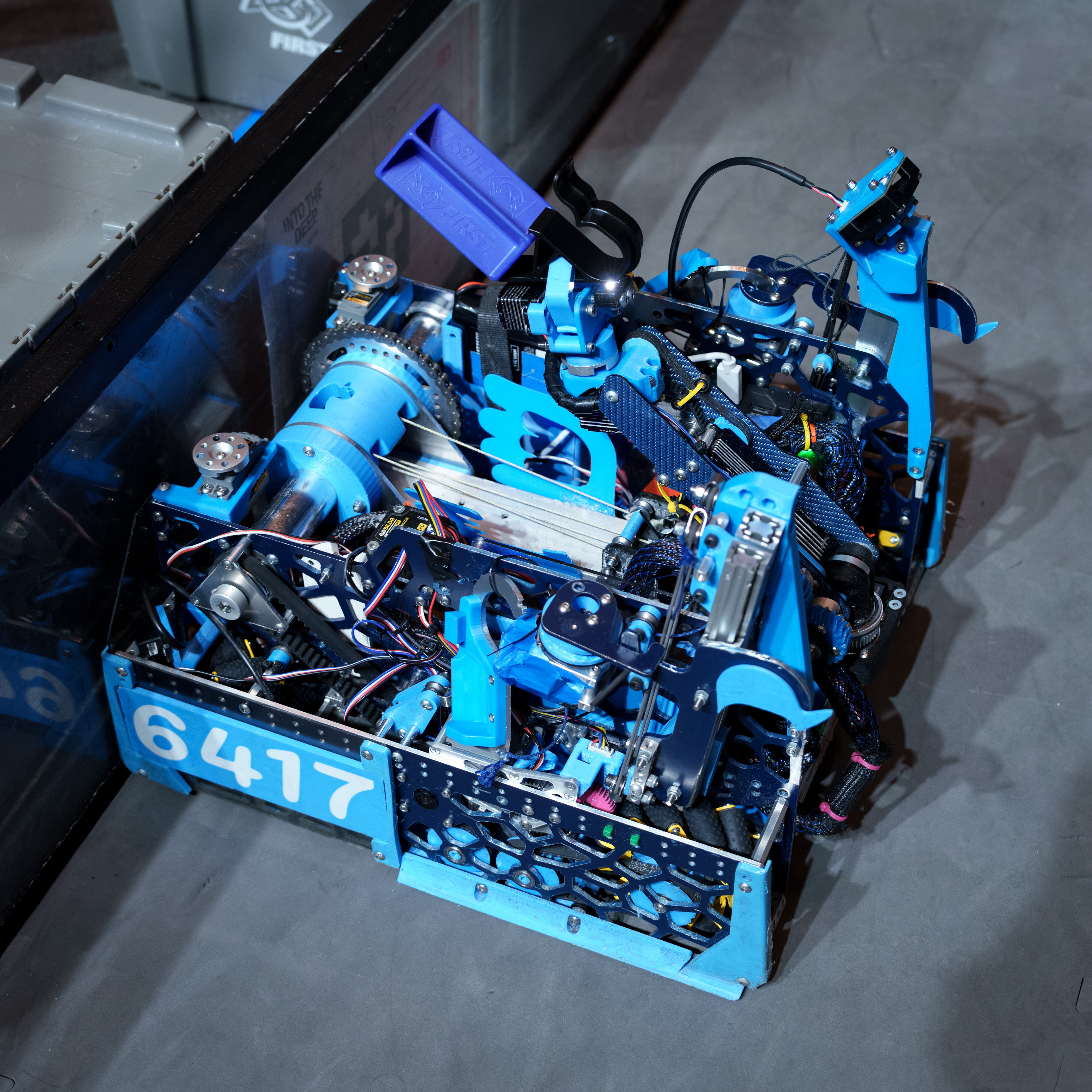
An all-in-one robot that intakes and scores with a single telescoping arm, eliminating the need for a transfer mechanism entirely. Evolved from our States robot, Wartortle.
- Peaked at 7th Offensive Power Rating worldwide
- Finished 9/64 at the World Championship
- Placed 13th of 40 at the Multinational Tech Invitational
Telescoping Arm
- Three-stage telescoping tube system with 34 inches of extension
- Cascade-strung with two sets of strings — the second is a backup that improves consistency
- Custom bearing blocks constrain both the inside and outside of the tubes
- Chain-and-sprocket pivot with a custom tensioner at a 152.7:1 ratio — 39 RPM, 205.2 kg·cm of torque
- Pivot is over 80% custom; the arm is pocketed to reduce weight
End Effector
- All-in-one intake/outtake removes the transfer mechanism entirely, embodying the KISS principle
- Active/passive combination: a belt-driven spinner for fast intaking plus a sample-conforming latch for reliable scoring
- Four degrees of freedom — pitch control for multiple scoring angles, rotating wrist for roll control from either side
- Sample-aligning geometry and a limit switch detect and square up blocks
- A scissor-linkage pusher (225 mm extension) was added after Qual 1 to reach vertical blocks at the submersible edge
Two-Stage Hang
- One-of-a-kind passively sprung two-stage hanger with magnetic hooks
- Level 2 uses a sprung bungee cord for instant extension, bracing on the submersible to minimize required torque
- Level 3 uses the extension's own speed to throw the magnetic hooks up, with a separate high-torque motor lifting the robot
- A dual-purpose servo acts as both latch and high-torque retraction winch
Drivetrain
- Custom CNC-machined plates with motors embedded into the sides to save space
- Motors lowered to drop center of mass, validated in Onshape center-of-mass simulation before building
- Two dead-wheel odometry pods for localization
- Polycarbonate covers and ramps stop samples falling into the robot
Software
- Affine transformation matrix inverse kinematics relate robot center to end-effector position
- Cubic Hermite splines smoothly control end-effector pathing
- Custom point-to-point PID pathing replaced Road Runner, which was slow and did not correct at the end of trajectories
- AprilTag localization corrects odometry drift, using a linked list of past positions to extrapolate around reading latency
- Voltage compensation normalizes motor power to 12V so behavior stays consistent as the battery drains